The story
A quiet house for old stone
Aether Frieze began with a single fragment — six mounted figures in low relief, bought at dawn from a family who had kept it above a kitchen fire for three generations. The stone was warm. It has never entirely cooled.
We are not a shop and we do not keep stock. We keep rooms: long, cream-walled, lit from the east, where a frieze can be read the way it was carved to be read — at walking pace, in morning light, in silence. When a piece leaves us, it leaves by appointment and by word, the way it arrived.
AF · Atelier
The first bench
Where every arrival rests
The atelier practice
Three movements, done slowly
-
The mould
Every studio cast begins from a master taken by hand — silicone laid against original stone one thin wash at a time, so the chisel’s rhythm survives in the negative. A mould is used twelve times, then retired and dated.
-
The cut
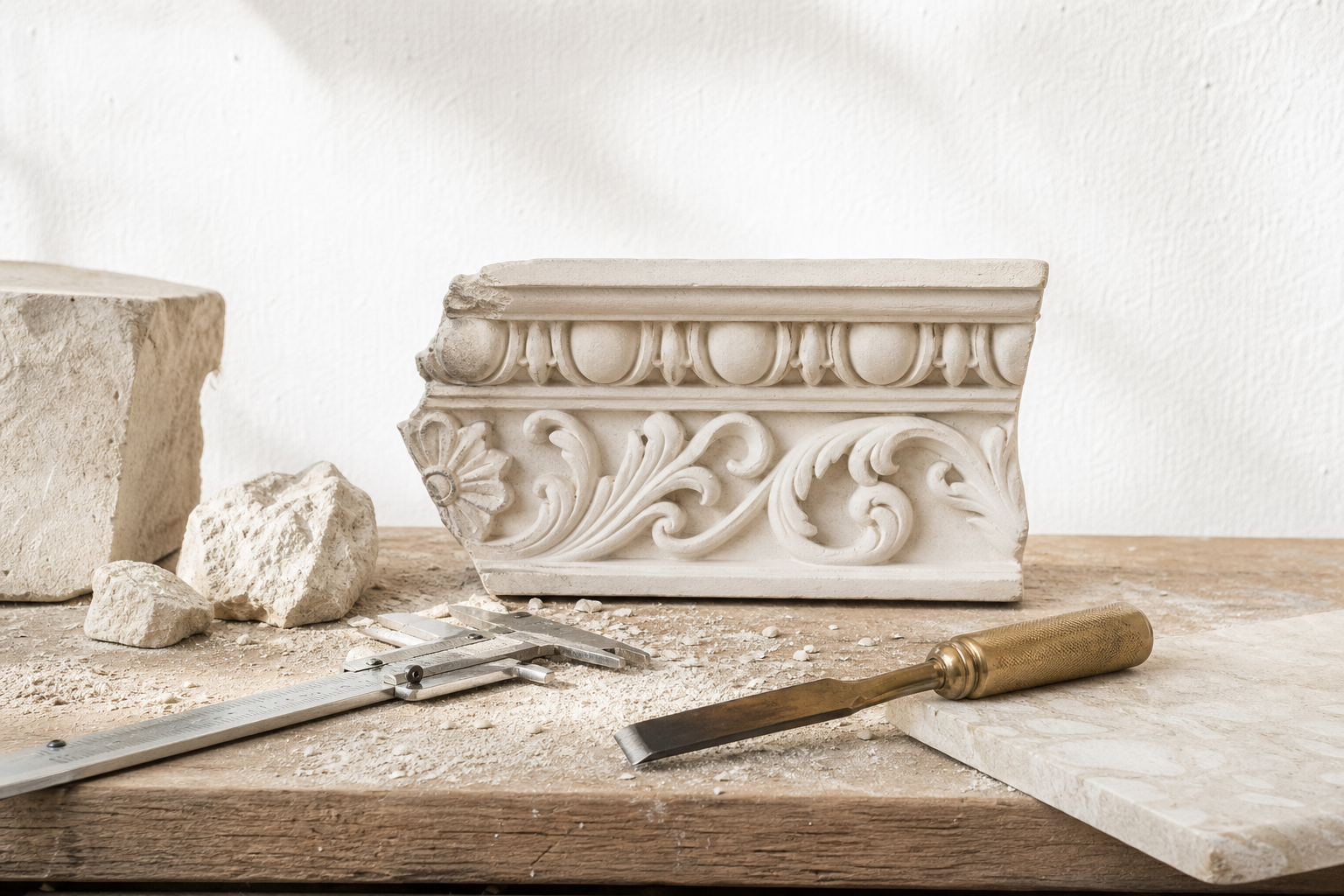
Fragments are conserved, never restored past the break. We clean with water and soft brushes, consolidate only what is friable, and cut new mounts from bronze bar — thin, matte, and reversible, so the stone can always go back to being alone.
-
The finish
Each piece is hung against plaster for one full week and watched at first light before it is offered. If the stone does not hold the morning — if it glares, or dies flat — it stays in the atelier until it does.
Provenance
Every stone arrives with a ledger
We buy slowly and we document everything. Nothing enters the rooms without a written line of hands, and nothing leaves without one more name added to it.
-
Ledger · I
Documented line of ownership
Each acquisition carries its papers — collection records, export licences, and the names of the rooms it has lived in, as far back as the record reaches.
-
Ledger · II
Pre-1970 sourcing only
Fragments enter our rooms exclusively from old European and island collections with established histories. We do not handle material without a pre-1970 footprint.
-
Ledger · III
Conservation before commerce
A conservator’s report precedes every offer. Condition, prior intervention, and stability are written down and handed over with the stone itself.
-
Ledger · IV
Signed, numbered atelier editions
Studio casts and editions carry the atelier mark, an edition number, and a mould-retirement date — small print runs, closed permanently.
The rooms, at opening hour
Come and see the stone hold the morning.
Write to the atelier and we will keep an hour for you, east window first.
Send word